Which Countries Have the Most (and Fewest) Public Holidays in 2026?
Fact-Checked & Reviewed by the OnlineTimeZone Editorial Team. Data verified against national government gazettes, labor regulations, and the official 2026 Pew Research dataset.
Ever wonder why your colleague in Dhaka seems to always be on holiday, while your counterpart in Zurich is grinding away? It’s not your imagination. The gap between countries with the most and fewest public holidays is surprisingly wide. The reasons behind it reveal how different cultures approach work, religion, and national identity.
We analyzed data across 190 countries to bring you the most comprehensive look at global public holidays in 2026. Whether you are a remote worker coordinating across time zones, a traveler planning trips around national closures, or just curious how your country stacks up—this is the article for you.
The Global Average: 13 Days Off
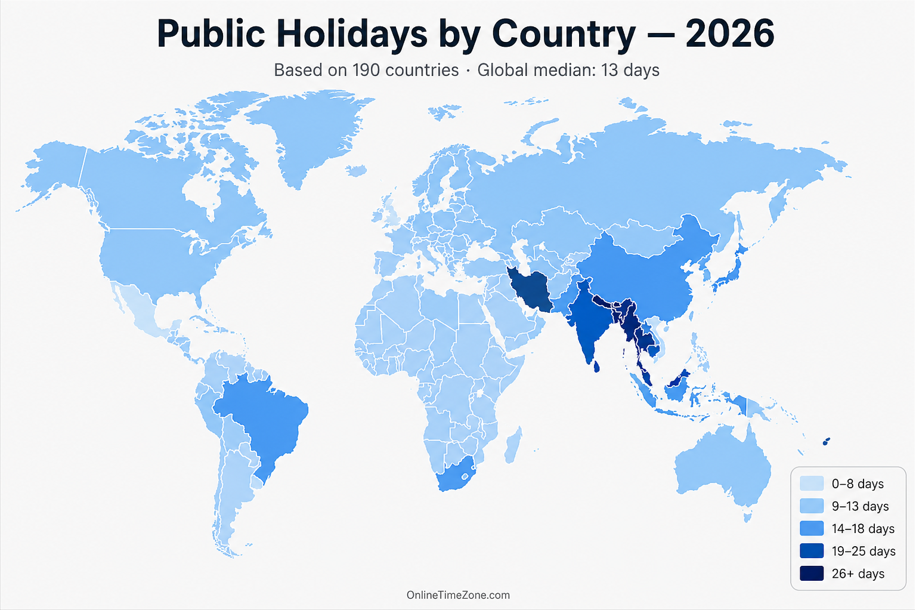
Before we get into the extremes, here is your baseline: the typical country observes 13 public holidays in 2026. That is according to a Pew Research Center analysis of 190 UN member countries, verified against national labor codes and government publications.
The United States, for comparison, recognizes 11 federal public holidays. This is slightly below the global median. It is not particularly generous, but it is far from the bottom of the list.
Quick Insight: The analysis covered nearly 2,500 individual public holidays across 190 countries. Ukraine was excluded because its public holidays for 2026 are suspended under martial law.
Countries With the MOST Public Holidays in 2026
1. Nepal — ~35 Holidays
Nepal tops the global list. Nepal consistently ranks first because of its rich mix of Hindu, Buddhist, and indigenous Kirant festivals. The country observes multiple New Year celebrations (Nepali, Tibetan, Tharu), dozens of Hindu festivals, Buddhist events, and various national days. Nepal’s calendar treats the year as a continuous chain of celebrations. (You can track these dates using our Date Calculator tool).
2. Myanmar (Burma) — ~30 Holidays
Myanmar is among the most holiday-rich countries. The reason lies in its deep relationship with Buddhism and its traditional lunar calendar. Myanmar’s holiday schedule is notable for including:
* Multiple days for the Thingyan Water Festival (Burmese New Year) — usually 4 consecutive days
* Full moon days commemorating key events in the life of the Buddha
* Lunar New Year celebrations
* National days including Independence Day, Union Day, Armed Forces Day, and Martyrs’ Day
The Burmese calendar operates on a lunar system. This means many holidays shift dates every year—the same reason Eid and Diwali fall on different calendar dates annually. (See our World Clock to check the live local time in Myanmar).
3. Bangladesh — ~29 Holidays
Bangladesh formally recognizes celebrations from four major religions. Bangladesh is predominantly Muslim (~90%), but it has significant Hindu, Buddhist, and Christian communities. The result is a calendar that includes:
* Multiple days for Eid al-Fitr and Eid al-Adha (Islam)
* Durga Puja and Janmashtami (Hinduism)
* Vesak / Buddha Purnima (Buddhism)
* Christmas (Christianity)
* National days: Independence Day, Victory Day, Language Martyrs’ Day, and national election holidays
The Islamic calendar is about 10 to 11 days shorter than the solar calendar, so Islamic holidays shift backward through the seasons. This means some Islamic observances can fall twice in a single Gregorian calendar year. For example, Iran’s birthday of Imam Ali appears on both January 2 and December 23 in 2026.
4. Sri Lanka — ~25 Holidays
Sri Lanka makes the top tier for a similar reason to Myanmar. It is a majority-Buddhist country where every full moon day is a public holiday. These are called Poya days, and there are 12 of them per year. Add national holidays, Hindu Tamil holidays, Christmas, and Eid, and you have a very full holiday calendar.
Sri Lanka’s approach is unique. By tying these Buddhist Poya holidays to the lunar cycle, the entire population observes a monthly rhythm of rest. (You can set reminders for these monthly moon cycles with our Online Timer).
5. Malaysia — ~24 Holidays
Malaysia observes holidays for Islam (Eid, Prophet’s Birthday), Chinese culture (Chinese New Year, spanning two national days), Hinduism (Deepavali, Thaipusam in some states), and Christianity (Christmas). Add Malaysia’s national and royal days, and you get one of the highest holiday counts in the world.
Other Top-10 Countries in 2026:
* Fiji — ~23 holidays (Christian, Hindu, and national days)
* Iran — ~22 holidays (Islamic calendar; some holidays fall twice)
* Liechtenstein — ~22 holidays (extensive Catholic holiday calendar)
* India — ~21 national holidays (state-level additions push the real count higher)
* Cambodia — ~21 holidays
Planning Meetings Across Time Zones?
Avoid scheduling conflicts with global holidays. Use our free Time Zone Converter and World Clock to coordinate meetings and travel effortlessly.
Open Time Zone Converter →Countries With the FEWEST Public Holidays in 2026
1. Switzerland — Technically Just 1 Federal Holiday
Switzerland has just one federal public holiday: Swiss National Day on August 1st. Before you feel sorry for Swiss workers — they are fine. Switzerland operates on a decentralized system where each of its 26 cantons sets its own holiday schedule. Every canton observes at least 9 holidays. Some cantons, like Fribourg and Lucerne, observe as many as 15. Others, like Vaud or Valais, offer 9.
It is a good reminder that the number of nationally mandated holidays does not tell the whole story.
2. Bosnia and Herzegovina — ~4 National Holidays
Bosnia’s situation reflects its complicated post-war political structure. The country is split into two main self-governing regions with different religious and national days. Agreeing on a unified national holiday calendar is difficult. This results in very few holidays recognized at the national level. This is a clear example of how political history — not work culture — drives low holiday counts.
3. Uruguay — ~5 Holidays
Uruguay is one of Latin America’s most secular countries. Even holiday names have been changed to be secular. For example, “Semana Santa” (Holy Week) became “Semana de Turismo” (Tourism Week), and “Día de Reyes” (Three Kings Day) became “Día de los Niños” (Children’s Day). Its low holiday count is a direct result of strict secular laws.
4. Mexico — ~8 Holidays
Mexico is famous for vibrant festivals. Yet, it recognizes only a small number of mandatory holidays at the federal level. Events like Day of the Dead and Cinco de Mayo are culturally enormous but are not mandatory public holidays. Only statutory holidays are legally required days off.
5. United Kingdom — ~8–9 Holidays
England and Wales get 8 bank holidays, Scotland gets 9, and Northern Ireland gets 10. The UK has historically maintained a work-centric culture. However, British workers often negotiate more annual leave in their contracts to compensate.
Other Low-Count Countries:
* Netherlands — ~9 holidays
* Serbia — ~9 holidays
* Vietnam — 11 days off (across 6 distinct holiday events. While Vietnam has a rich cultural calendar, it officially groups its public holidays into 6 main events. Multi-day celebrations like Lunar New Year (Tết) span 5 consecutive days off, totaling 11 days off overall).
The Holidays Almost Everyone Shares
Across all this variety, a handful of holidays show up almost everywhere on Earth:
- New Year’s Day (January 1) — observed in at least 169 countries. It is the most universally shared day off on the planet.
- International Labor Day / May Day (May 1) — a public holiday in at least 144 countries. It is notably absent from the US and Canada, which observe Labor Day in September instead.
- Christmas (December 25) — observed as a public holiday in at least 154 countries, including many with very small Christian populations.
- Independence / National Day — almost every country has one, though a handful including Denmark and the UK do not observe it as a formal public holiday.
Interestingly, at least 52 countries observe public holidays for both Christmas and at least one major Eid. More than half of these are in Africa, reflecting the continent’s religious diversity.
A Special Case: India’s Holiday Complexity
India deserves its own section because its holiday situation is unique. Nationally, India recognizes about 21 public holidays. However, the real number experienced by any given Indian employee can be significantly higher — or just 3, depending on where you work.
The three national holidays are Republic Day (January 26), Independence Day (August 15), and Gandhi Jayanti (October 2). Everything else is decided at the state level. Each of India’s 28 states celebrates its own harvest festivals, regional new years (Onam in Kerala, Baisakhi in Punjab, Gudi Padwa in Maharashtra, Ugadi in Andhra Pradesh), and birth anniversaries of local leaders.
The result is that someone working for the central government in Delhi follows one calendar, while someone in Chennai or Kolkata observes an entirely different set of days. India’s diversity is literally written into the official calendar.
What Actually Determines How Many Holidays a Country Has?
After looking at this data, a few clear patterns emerge:
- Religion — and how many traditions a country officially recognizes. Countries recognizing multiple religions on their national calendar (Bangladesh, Malaysia, India, Sri Lanka) tend to have higher counts. Secular countries often have fewer.
- Lunar vs. solar calendars. Countries following lunar calendars often end up with more holidays because lunar months do not align neatly with solar months. In some years, the same holiday falls twice in one solar year.
- Political decentralization. When a central government does not mandate holidays, national counts stay low even if workers actually take plenty of days off. Switzerland and Bosnia are the clearest examples.
- History and colonial legacy. Many countries inherited their holiday structures from colonial powers. They then layered new national days on top, adjusted them, or scrapped them entirely.
- Work culture norms. In some countries, low official holiday counts are offset by generous annual leave or strong union protections. In others, low holidays and low annual leave compound each other.
Does More Holidays = Better Work-Life Balance?
Here is the honest answer: not necessarily.
Myanmar and Bangladesh top the holiday charts, but many workers in informal sectors do not receive paid days off. A formal public holiday means less if you are self-employed, in agricultural work, or in the gig economy.
Countries like Germany (10–13 holidays), Denmark (~11 holidays), and the Nordic nations have fewer public holidays than South Asia. However, they consistently rank among the best in the world for work-life balance. This is thanks to strong labor protections, mandatory annual leave, and cultural norms that honor personal time.
The number of public holidays is just one piece of the puzzle. How rigorously those days are protected — and how workers are treated on every other day — matters just as much.
How Does Your Country Compare? (Quick Reference)
| Country | Public Holidays (2026) | Notes |
|---|---|---|
| Nepal | ~35 | Typically #1 globally |
| Myanmar | ~30 | Buddhist lunar calendar |
| Bangladesh | ~29 | Four religions on calendar |
| Sri Lanka | ~25 | Monthly Poya (full moon) days |
| Malaysia | ~24 | Multi-religious recognition |
| Fiji | ~23 | Combined Christian + Hindu + national |
| Iran | ~22 | Some holidays fall twice (lunar calendar) |
| Liechtenstein | ~22 | Extensive Catholic calendar |
| India | ~21 | State-level additions push this higher |
| Cambodia | ~21 | Buddhist and national holidays |
| Brazil | ~16 | Varied municipal days |
| Japan | ~16 | Standard national holidays |
| South Africa | ~13 | Near the global median |
| Australia | ~12–13 | Varies by state |
| Germany | ~10–13 | Varies by state |
| USA | ~11 | Slightly below global median |
| UK (England) | ~8 | One of Europe's lowest |
| Mexico | ~8 | Only statutory holidays counted |
| Netherlands | ~9 | Varies by trade agreement |
| Uruguay | ~5 | Highly secularized calendar |
| Bosnia & Herzegovina | ~4 | Decentralized political structure |
| Switzerland | ~1 (federal) | Cantons add 8–14 more |
Planning Around Global Holidays
If you are scheduling international meetings, planning travel, or running a distributed team, public holidays across time zones are a real operational headache. A few practical tips:
- When working with South Asian teams, note that India, Bangladesh, and Sri Lanka observe significantly more holidays than Western counterparts. Build buffer time around major religious festivals (Eid, Diwali, Buddha Purnima).
- For US–Europe coordination, European holidays are less predictable for American teams. They include things like Assumption Day, Epiphany, and various national days that US workers may not know.
- The Muslim world’s calendar shifts annually. Eid al-Fitr and Eid al-Adha fall approximately 11 days earlier each solar year. Always check updated dates for the current year.
- China’s Golden Week and Spring Festival are not traditional public holidays in this sense, but they involve massive societal shutdowns that dwarf anything in the West.
Final Thought
Public holidays are a society’s official answer to the question: what do we choose to stop for? Whether it is the full moon, the birth of a prophet, the day a colonial power was expelled, or simply the arrival of a new year — what a country pauses for tells you something real about what it values.
The gap between Myanmar’s 30+ days of officially sanctioned rest and Switzerland’s single federal holiday is not just a scheduling quirk. It is a window into two very different ideas about the relationship between time, work, community, and the sacred.