The Real Reason Middle Schoolers Run Out of Time (Ages 12–14)
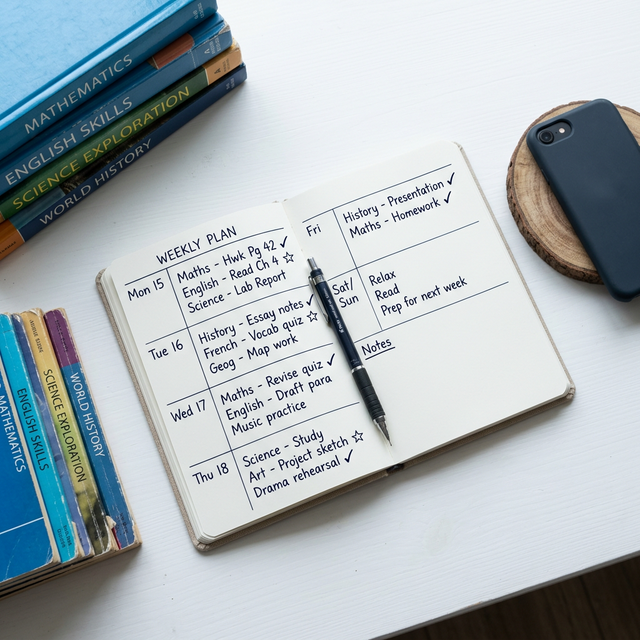
Ask any middle school student where their afternoon went and they will tell you they do not know. That is not an excuse — it is accurate. Time at ages 12 to 14 does not feel like it passes. It evaporates. One moment it is 4 PM and there is plenty of time. The next it is 9 PM and the assignment due tomorrow has not been started. This is not laziness. It is what happens when a developing brain encounters unstructured time and no system to manage it.
The good news is that the system does not need to be complicated. It needs to be used.
Why this age is the make-or-break window
Elementary school routines were mostly maintained by parents. High school will demand genuine self-direction. Middle school is the gap between those two states — and what happens in this gap determines which direction the next five years go.
The prefrontal cortex, which handles planning, prioritisation, and impulse control, will not fully mature until the mid-20s. This is not an excuse — it is context. It means that at 12 to 14, students cannot reliably self-organise through willpower alone. They need external systems that do the cognitive heavy lifting. The students who build those systems in middle school arrive at high school already functioning. The students who do not spend Year 10 trying to build the foundation they should have laid in Year 7.
Here is the thing nobody tells students directly enough: the gap between a student who does well and a student who struggles is almost never intelligence. It is almost always organisation. That is genuinely good news, because organisation is a skill. Skills can be built.
The methods that actually work
1. The Sunday brain dump — the most underrated 15 minutes of the week
Here is what Sunday evening looks like for most middle school students: a vague awareness that the week ahead exists, a hope that it will somehow be manageable, and a feeling of low-grade dread that they push away by watching something.
Here is what it could look like: take a blank piece of paper and spend 10 minutes writing down everything — every assignment, every test, every project, every after-school thing — in whatever messy order it comes to mind. Then spend 5 minutes sorting it by day. That is the entire system. 15 minutes, once a week.
The students who do this do not forget assignments. Not because they have better memories, but because they have externalised the tracking to paper instead of leaving it rattling around in their head. The brain is not a reliable to-do list. Paper is.
2. The Most Important Task — hardest thing first, every day
Most students do homework in the wrong order. They start with what is easiest — a worksheet, a light reading task, something that feels like progress without requiring much effort. The hard thing gets pushed to the end. By the time they reach it, they are tired, it is late, and the work produced is the worst version of what they could have done.
Reverse the order. Every day, identify the one task that most needs to be done — the hardest, the most important, or the one with the nearest deadline. Do that first. Everything else after.
This is uncomfortable for the first week. After that, it becomes the most reliable productivity decision a student can make, because starting the hard thing when energy is highest produces results that starting it at 9 PM simply cannot match.
3. Fake deadlines — the trick that removes all-nighters before they happen
For anything due Friday, write Thursday as your deadline. For anything due in two weeks, set your personal deadline two days earlier. Write the fake deadline in your planner. Tell yourself it is real. Treat it as real.
This is not a trick for overachievers. It is protection against the completely normal events that derail real deadlines: a bad night's sleep, a forgotten sports kit that needs sorting, a family thing that appears from nowhere, a day when the brain simply will not cooperate. The buffer catches all of those. Without it, each of those events becomes a crisis.
4. Phone in another room — not face down, not in a bag, another room
This will be the least popular tip in this article. It is also the most impactful one.
Research from the University of Texas found that having a smartphone within sight — even face down and silent — measurably reduces available cognitive capacity. The brain allocates a portion of its attention to monitoring the phone even when it is not being used. That portion is not available for homework.
The objection is always "but I need it for music" or "I need it to check something." Music from a speaker works. Checking something can wait 20 minutes. The discomfort of not having the phone nearby is exactly the feeling of the brain re-learning to focus without a constant escape route. That discomfort is the point, not a side effect.
Time your study blocks for free
Use our free countdown timer to run 30-minute focused study sessions with a proper break built in. Works on any device, no app needed.
Set a Study Timer →The real reason students procrastinate — and it is not what they think
Most students believe they procrastinate because they are lazy or unmotivated. Almost none of them are right. Procrastination at ages 12 to 14 is almost always one of three things.
The task feels too large to start. The fix is to make it smaller: not "do the history project" but "write the first paragraph of the introduction." Something so small it is embarrassing to say you could not do it.
The task is unclear. Students stare at an assignment and do not know what the first action is. The fix is to write the next physical action before stopping work each day: "tomorrow I need to open the textbook to page 47 and read the section on the water cycle." The next action is decided in advance, so starting tomorrow requires no decision.
The task is associated with a bad feeling — boredom, confusion, past failure. The fix is not to change the feeling before starting. It is to start anyway and allow the feeling to change through action. Motivation follows action far more reliably than action follows motivation.
A sample weekday plan for ages 12–14
| Time | Activity |
|---|---|
| Before school | Write today's most important task on a sticky note. Put it on the desk. |
| After school | 15-minute decompression, no screens, snack and movement |
| 4:00 PM | Most important task first, phone in another room, 30 to 40 minutes |
| 4:45 PM | Break, 10 minutes, stand up and move |
| 4:55 PM | Second task or remaining work, 25 to 30 minutes |
| 5:30 PM | Pack bag, check tomorrow's timetable |
| Sunday, 7 PM | Brain dump and weekly sort, 15 minutes total |