Why Smart High School Students Still Fail at Time Management (Ages 15–18)
Here is the thing about high school time management advice: most of it is written for students who are already fairly organised and just need a few refinements. It talks about Pomodoro timers and Sunday planning rituals as if the problem is that students do not know these techniques exist.
That is not the problem. Most high-achieving students have heard of Pomodoro. Most of them have bought a planner at some point. The planners are in a drawer. The Pomodoro sessions lasted four days.
The real problem is not knowledge. It is that time management at ages 15 to 18 is competing with the most powerful motivational force in adolescent life: the present moment. The exam is in three weeks. The group chat is right now. Understanding that tension — and designing systems that acknowledge it rather than pretending it does not exist — is what actually works.
What makes high school different from everything before it
The stakes are real for the first time. GCSE grades, A-level results, predicted grades for university applications — these are outcomes that close doors if they go wrong and open them if they go right. Most students know this intellectually. Knowing it does not automatically produce the sustained daily behaviour required to influence those outcomes.
The time is there. A typical sixth-form student has 4 to 5 hours of free time on a school day. The problem is not shortage of time. It is that those hours arrive fragmented, after an exhausting day, in an environment full of social demands, and without any external structure forcing them to be used well.
The students who do well at A-level are not the ones who study the most hours. They are the ones who protect the quality of the hours they study. That distinction matters more than almost anything else in this article.
The methods that actually work
1. Time blocking — because a to-do list is a wish list
A to-do list is a collection of intentions. It does not tell you when. It does not protect time. It does not prevent the afternoon from dissolving into scrolling with a textbook nearby that you technically could open at any moment.
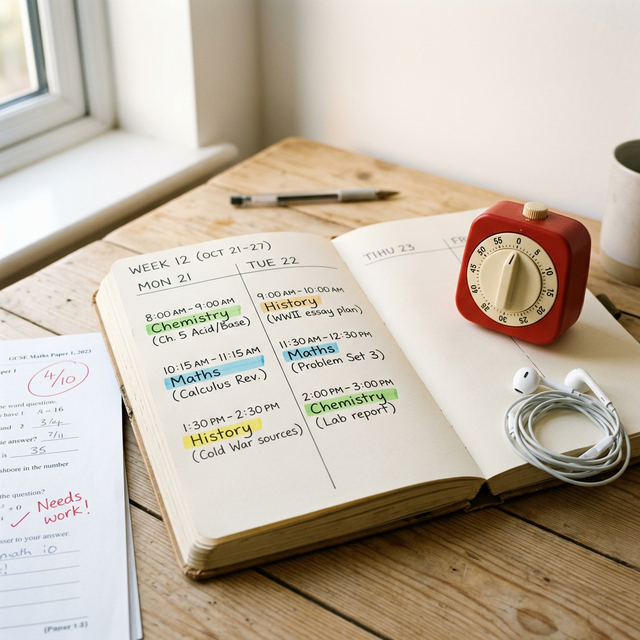
Time blocking is different. You open your calendar and assign specific subjects to specific slots: 4 to 5 PM is Chemistry. 7 to 8 PM is the History essay. 8 to 8:30 PM is Maths review. These are not suggestions — they are appointments. When 4 PM arrives, the decision is already made. There is no moment of weighing up whether you feel like Chemistry. You are doing Chemistry.
That single removal of the decision is worth more than most students realise until they try it. Block the time before the week starts. Sunday evening, ten minutes. Schedule every subject that needs attention. If something urgent comes up and a block gets moved, reschedule it — do not delete it.
2. The Pomodoro Technique — but actually doing it properly
Most students who say Pomodoro does not work for them tried it for three days with their phone on the desk. That is not the Pomodoro Technique. That is sitting near a timer.
The technique requires four things simultaneously: a timer set for exactly 25 minutes, phone physically out of the room, one task only for the entire 25 minutes, and a genuine stop when the timer rings even if you are mid-sentence. The 5-minute break is not optional — it is the mechanism that prevents the fatigue accumulation that makes the later sessions useless.
Used properly, it works because the 25-minute window creates urgency. The brain knows time is limited and focuses accordingly. Used improperly — with distractions present, with the phone nearby, with breaks skipped — it is just a timer app producing no benefit while generating the false belief that you tried the technique.
3. The Sunday reset — 30 minutes that protects the entire week
Sunday evening. Thirty minutes. This is not negotiable.
Review what did not get done last week and why — not to feel guilty but to problem-solve. Write every deadline and commitment for the coming week. Time-block your study sessions. Prepare your bag, uniform, and materials. Check that everything due Monday is done.
Students who do this describe Monday morning as fundamentally different from students who do not. They walk in already oriented. They are not discovering on Monday morning that something was due. They are executing a plan that already exists.
The students who skip this most often are the ones who most need it — students whose weeks feel chaotic and reactive. The Sunday reset is exactly the thing that turns a reactive week into a managed one.
4. Match the task to your energy — not to your guilt
Most students do homework in guilt order, not energy order. The assignment they feel worst about avoiding goes last because it is most associated with dread. This is exactly the wrong approach.
Track your energy for one week. Notice when you are sharp — genuinely sharp, not just awake — and when you are flat. For most people there is a clear peak in the morning or early afternoon and a dip in the late afternoon. Reserve the peak for the work that requires the most cognitive effort: essays, problem sets, anything that needs sustained analytical thinking. Use the dip for lighter tasks: reviewing notes, reading, organising.
The gain from matching task difficulty to energy level is not marginal. Working on a complex essay during a peak produces results that working on it during a dip cannot match regardless of how much longer you sit there.
Run proper Pomodoro sessions — free, no app needed
Set your 25-minute Pomodoro timer here. Works on any device. No account, no download. Put your phone in another room and use your laptop timer instead.
Start a 25-Minute Pomodoro →The exam preparation mistake almost every student makes
Here is an uncomfortable truth: the revision technique used by the majority of students — re-reading notes and highlighting — is one of the least effective methods identified by memory research. It produces a feeling of familiarity that students confuse with understanding. In an exam, familiarity is not enough.
The revision techniques that work are the ones that are harder and less comfortable: practice questions under timed conditions, covering notes and trying to write what you remember, explaining a topic out loud without looking at anything, completing past papers in exam conditions.
Start past papers three weeks before the exam, not three days. One paper per subject per week minimum. Mark them honestly. The gaps that appear are the things to study — not the things you already understand and keep revising because they feel comfortable.
The thing about phones that nobody says plainly enough
A 2022 study tracked how often teenagers check their phones during periods they describe as studying. The average was once every 6 minutes. Each check, even a brief one, costs approximately 20 minutes of recovered concentration. In a 2-hour study session with unchecked phone access, that translates to roughly 40 minutes of actual focused work out of 120.
This is not a moral judgement about phones. It is arithmetic. If the phone is in the room, the study session produces a fraction of what it could. If the phone is in another room, the session produces something close to its full potential. The variable is not intelligence, effort, or motivation. It is location of a device.
Calculate exactly how many days until your exam
Know your exam date? Find out exactly how many days you have left to prepare — and start those timed past papers three weeks before, not three days.
Count Days to My Exam →A realistic school week schedule for ages 15–18
| Time | Activity |
|---|---|
| Sunday, 7–7:30 PM | Weekly reset: review, plan, prep bag, set time blocks for the week |
| Mon–Fri, 4–5 PM | Hardest subject of the day, phone in another room, Pomodoro running |
| Mon–Fri, 5–5:15 PM | Break, move, eat, go outside briefly |
| Mon–Fri, 5:15–6:30 PM | Second study block or extracurricular |
| 3 weeks before any exam | Begin timed past papers, one per subject per week minimum |
| Night before any exam | Light review maximum 60 minutes, then stop, then sleep |