Time Management for Kids Who Hate Being Told What to Do (Ages 8–11)
Here is something no parenting article will tell you: the average child spends 27 minutes arguing about homework for every 20 minutes they actually do it. That number is not from a study — it is from every parent who has lived through a Tuesday afternoon. The real time management problem at ages 8 to 11 is not the homework. It is the negotiation that happens before the homework. Fix that, and everything else becomes easier.
Why these years matter more than they look
Elementary school feels low stakes. No university applications, no final exams, no real consequences. That feeling is exactly what makes this age so important — and so easy to waste.
The brain between ages 8 and 11 is in one of its most plastic phases. Habits formed now do not just stick — they become automatic. A child who builds a homework routine at age 9 will not need to rediscover discipline at 15. It will already be wired in. A child who doesn't will spend their teenage years fighting the absence of a foundation they never built.
The uncomfortable truth parents rarely hear: most homework battles are not about the child being difficult. They are about the environment being poorly designed. Change the environment, and you change the behaviour — without a single argument.
The methods that actually work
1. The fixed after-school routine — and why it ends the arguments
The negotiation happens because nothing is decided yet. Every afternoon is a fresh debate: when, where, how long, what first. The fix is not better persuasion. It is removing the decision entirely.
Set one sequence and stick to it every weekday: arrive home, snack, 15 minutes of free play, homework, free time. Same order, same time, same spot. The first two weeks will feel like you are fighting the routine. By week four, most children start without being asked — because the brain has automated it. The habit does the work. You stop doing the work.
The order matters as much as the clock time. Do not send a child straight from the school bus to the desk. A 15-minute buffer of snack and movement after school is not indulgence — it is biology. The brain needs a transition.
2. The 20-minute timer — and why it beats "sit there until it's done"
"Sit there until it's done" is the worst homework instruction a parent can give. It has no end point, which the brain finds genuinely threatening. It produces resentment, not focus.
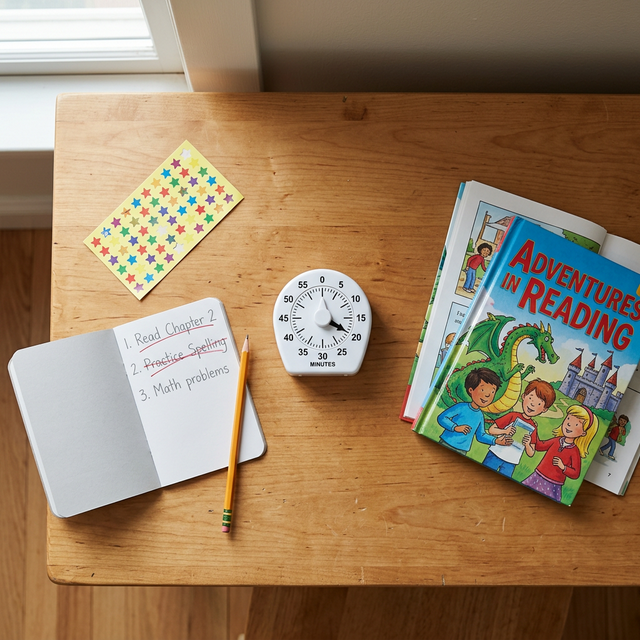
Set a physical kitchen timer for 20 minutes. Not an app — a physical timer the child can see counting down. When it rings, stop. Full stop. Take a 10-minute break. Then set it again. This is not about being soft on homework. It is about matching the actual attention span of an 8 to 11-year-old, which research puts at 16 to 24 minutes. Working within that window produces better quality work than forcing a child past it.
One subject at a time. No exceptions. The moment a child is doing homework while half-watching a sibling play or half-listening to the TV, the 20 minutes produces 8 minutes of actual learning. The environment has to be boring enough that the work is the most interesting thing available.
3. The 3 Things list — and why short beats long
Ask a child to write down everything they need to do and watch their face. Overwhelm is immediate. The list feels like a wall. Nothing gets started.
Three things. Every day. That is the entire system. Write three tasks — not 10, not 5 — in a small notebook kept in one fixed spot. Cross them off when done. The crossing-off matters more than it sounds. Completion feels good in a tangible, physical way that ticking a checkbox on a phone does not. That feeling is what makes children want to do it again tomorrow.
Most days, three things is genuinely all the homework there is at this age. On the days it is not, three things is still the right starting point — complete those first, then assess what remains. Starting small creates momentum. Momentum is the thing nobody can force.
4. The colour chart — and why ownership beats instruction
Tell a child what to do and they resist. Give a child something to do themselves and they protect it.
Put a large paper chart on the wall — the bigger the better. Use coloured stickers: yellow for homework, green for free play, blue for reading, orange for chores. Every day, the child places the stickers themselves. This is not decoration. This is ownership. A child who builds their own schedule will defend it. A child who receives a schedule will undermine it. The difference in compliance between the two approaches is not small.
Use a free online timer for homework sessions
A visible countdown timer is one of the most effective focus tools for children aged 8 to 11. Our free online timer works on any device — no download, no setup, no app.
Open the Free Timer →The honest part most blogs skip
None of this works immediately. The first week of any new routine feels worse than no routine because you are asking a child to change a pattern their brain has already settled into. Most parents try a new approach for four or five days, experience resistance, and conclude it does not work. Four to five days is not enough. Three to four weeks of consistent application is the minimum before a routine becomes automatic.
If you change the routine every time it produces friction, you are teaching the child that friction works. Consistency through the resistance is the entire mechanism.
What a good homework space actually needs
The physical environment has a measurable impact on focus that most parents underestimate.
A good homework space has five features. A fixed location used every single day — the location itself becomes a focus trigger over time. A clear surface with nothing on it except what is needed today. No screens visible or audible anywhere nearby. Good lighting, because poor lighting causes fatigue significantly faster in the late afternoon. And materials already in place — pencils, ruler, eraser — because searching for supplies breaks the momentum that is hardest to rebuild once lost.
The location does not need to be elaborate. A corner of the kitchen table that is cleared and designated works better than a bedroom desk that is never used consistently.
A realistic weekday schedule
| Time | Activity |
|---|---|
| 3:30 PM | Home, snack, 15 minutes completely free |
| 3:45 PM | Write the 3 Things list for today |
| 3:50 PM | Timer on, first 20-minute block |
| 4:10 PM | Break, move around, 10 minutes |
| 4:20 PM | Timer on, second 20-minute block if needed |
| 4:40 PM | Pack bag for tomorrow, 5 minutes |
| 4:45 PM | Free time, genuinely earned |